Family Court
About
Family Court Overview video transcript
District court judges designated as family court judges hear cases involving:
- Juvenile delinquency
- Abuse, neglect and dependency allegations
- Termination of parental rights
- Domestic violence
- Child custody and visitation rights
- Divorce and related financial issues like child support, alimony, and equitable distribution of property
Family court judges are experienced in dealing with family matters and receive specialized training to increase their expertise.
A major goal of family court is to consolidate and assign a family's legal issues before a single district court judge or team of judges. This allows family court judges to become familiar with and better address each family's issues, and keeps families from having to recount their history for multiple judges at each hearing.
Together, the dedicated family court judges and staff implement policies that promote prompt and just resolution of family law issues. Effective and intensive case management implemented by family courts includes:
- Court supervision of case progress
- A case assignment system
- Control of continuances
- Early dispositions and firm trial dates
Time standards vary by type of action but ideally family court issues will be resolved within a year of filing.
Publications
Unified Family Courts: Best Practices and Guidelines
Specific, essential, and successful practices identified in the years of Family Court experience in N.C.
Family Court Program Annual Report
Annual Reports on North Carolina’s unified family court programs.
Family Court Fact Sheet
Annual fact sheet on North Carolina’s unified family court programs.
Parent Education
Parent education programs make divorcing parents or parents living in separate homes aware of the needs of their children during and after the divorce process and when children are parented in separate homes. Court-sponsored parent education programs incorporate a video entitled The Most Important Job (Spanish version) that provides guidance for parents from professionals as well as from the child's perspective.
The Access and Visitation Program is grant-funded by DHHS and managed by the NCAOC to help connect non-custodial parents to their children. It includes coordinators in many of the Family Court districts who offer counseling and direct parents to local resources.
Family Court Programs
The General Statutes of North Carolina is the official North Carolina legal code, a collection of the statewide laws in force at the time of publication regardless of when they originally became law. The N.C. General Assembly offers access to the Statutes on the internet as a service to the public.
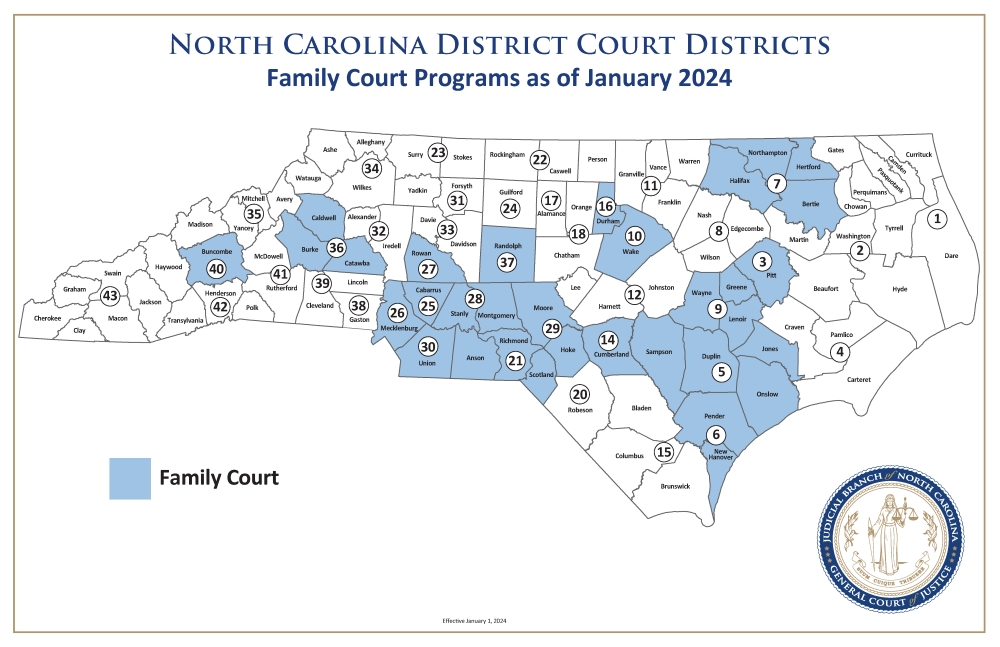
In accordance with N.C.G.S. Section 7A-34 and Rule 2 of the General Rules of Practice, districts often develop local rules or procedures to institute a case management plan with details about things like scheduling and court procedures. View the Local Rules and Forms page for any of the following counties to find local family court program rules and forms that are in effect for domestic and/or juvenile court in that county.
- District 3: Pitt
- District 5: Duplin, Jones, Onslow, and Sampson
- District 6: New Hanover and Pender
- District 7: Bertie, Halifax, Hertford, and Northampton
- District 9: Greene, Lenoir, and Wayne
- District 10: Wake
- District 14: Cumberland
- District 16: Durham
- District 21: Anson, Richmond, and Scotland
- District 25: Cabarrus
- District 26: Mecklenburg
- District 27: Rowan
- District 28: Montgomery and Stanly
- District 29: Hoke and Moore
- District 30: Union
- District 36: Burke, Caldwell, and Catawba
- District 37: Randolph
- District 40: Buncombe
Family Court Advisory Commission (FCAC)
The Family Court Advisory Commission (FCAC) provides a coordinated approach to the development, management, and evolution of North Carolina’s Family Court Program. Members of the FCAC meet quarterly and are appointed by the Chief Justice of the Supreme Court of North Carolina for a three-year term. Members include judges from both appellate courts, chief district court judges, clerks of superior court, family court administrators, custody mediators, guardians ad litem, domestic and juvenile attorneys, and various other court partners. The charge of the Commission is to:
- Advise the Chief Justice and the NCAOC Director on family court issues, including automation efforts;
- Set guidelines and standards of practice for all family court districts;
- Assure accountability for the family court program;
- Make recommendations about future legislative action, including needed statutory changes, budgetary suggestions, or recommendations for expansion of the program statewide;
- Review and make recommendations about the interrelationship between family courts and other court programs, such as guardian ad litem, child custody mediation, family drug courts, and family financial settlement; and
- Oversee the further development of the family court training curriculum.
View FCAC meetings and minutes.
View the Family Court Advisory Committee FY2021-22 fact sheet.
View the Family Court FY2021-22 fact sheet.
District Permanency Collaboratives
A District Permanency Collaborative (DPC) is a local group comprised of judges, attorneys, guardian ad litem, family court, child welfare leaders, and other stakeholders as needed. The focus of the DPC is to discuss permanency data (Permanency Performance Profile) and plans for improving permanency of children in juvenile abuse / neglect / dependency cases. Collaboration among these stakeholders increases safe and timely permanent exits from foster care. Each judicial district and / or county organizes their own DPC and may cover the focus topics in a regular meeting by another name.
Tools and resources, including the Permanency Performance Profile for every county, are available from the North Carolina Department of Health and Human Services Division of Social Services.
Contact
Contact your county court for more information.
Do you have a question or concern about a family court program?
Related Help Topics
Family and Children
Navigate the process for family-related cases, including custody issues, parental rights, child support, adoption, juvenile delinquency, and more.
Domestic Violence
How to get help, obtain a protective order, and relevant N.C. law.
Guardianship
Get information on how to become a guardian and what qualifications one must meet to obtain guardianship.
Obtaining Court Records
Find out how to obtain court records.